
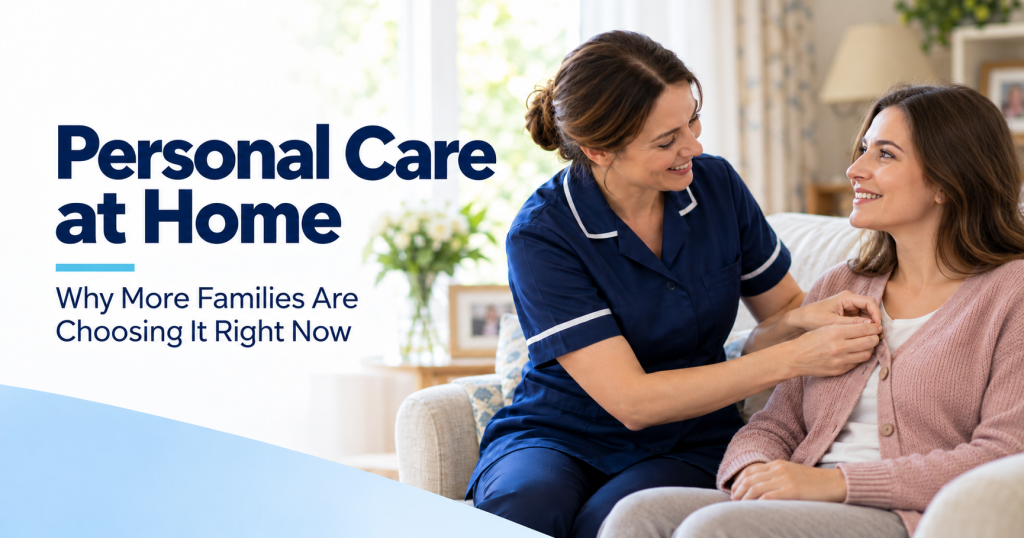
Personal Care at Home: Why More Families Are Choosing It Right Now
Personal care at home means help with everyday essentials – washing, dressing, mobility, meals, medication reminders, and daily routine support – delivered by a trained carer in someone’s own home, rather than in a care home or hospital. Great Life Care provides personal home care across England, built around the individual’s own routine, preferences, and pace.
If you’re weighing up options for yourself or a parent, “personal care” is probably the phrase that keeps coming up – and it’s often the first, smallest step families take before anything more clinical is needed. Here’s what it actually involves, and why so many families are leaning toward it right now.
What Personal Care at Home Actually Covers
At its core, personal care is about the everyday things that become harder with age, illness, or reduced mobility – the tasks that are easy to take for granted until they’re not.
That usually includes:
- Washing, bathing, and grooming
- Getting dressed
- Continence and toileting support
- Help with meals and eating
- Medication prompts and reminders
- Mobility support around the home
- General daily routine assistance
It’s rarely just the task itself, either. A good carer notices when something’s off – appetite changing, a new limp, more confusion than usual – and flags it early, before it becomes something bigger.
Why Personal Care at Home Is Trending Right Now
A few things have genuinely shifted how families approach this decision lately:
People want to stay independent, longer. There’s a strong and growing preference for ageing in place — staying in a familiar home, on your own terms — rather than defaulting to residential care. Personal care at home supports exactly that, without removing someone from their routine, their neighbours, or their own front door.
Care is getting more personalised, not less. The old model of a fixed 15-minute visit is giving way to care plans that actually flex around the person – their pace, their preferences, what a “good morning” looks like for them specifically.
Families want continuity. Seeing the same familiar carer, rather than a rotating cast of strangers, has become a real priority – it matters for trust, and it matters for spotting changes in health early.
Hospital discharge is pushing more people toward home support, faster. With hospitals under pressure to free up beds, personal care at home is increasingly the bridge between “medically fit to leave” and actually being safely set up at home.
Personal Care vs. Complex Care: What’s the Difference?
This trips a lot of people up, so here’s the short version. Personal care covers the everyday essentials — washing, dressing, meals, mobility, medication reminders. Complex care is a step up — for people with higher-level clinical needs, like PEG feeding, catheter care, or managing a long-term condition day to day.
Plenty of people start with personal care and only need to step up to something more complex later, if their needs change. A good provider should be able to move with you, rather than making you switch agencies partway through.
How Great Life Care Builds a Personal Care Plan
- A conversation first — understanding the person’s daily routine, preferences, and what the family actually needs help with.
- A proper assessment — looking at safety, health, and the home environment.
- A personalised care plan — built around the individual, not a generic template.
- The right career match — someone whose personality and experience genuinely fit.
- Care begins at home, with a proper introduction, not a stranger showing up cold.
- Ongoing review — because needs, however small, tend to change over time.
According to Age UK, one of the main benefits families report from home-based personal care is that it helps people retain a sense of control and independence — which is really the whole point of choosing it over other options.
Frequently Asked Questions
What is personal care at home?
Personal care at home is supported with everyday essentials – washing, dressing, mobility, meals, and medication reminders – delivered by a trained carer in someone’s own home rather than a care facility.
Who needs personal care at home?
It’s often chosen by older adults, people recovering from illness or surgery, or anyone whose daily tasks have become harder to manage safely alone. It’s frequently the first step families take before considering more complex support.
What’s the difference between personal care and complex care?
Personal care covers daily living tasks like washing, dressing, and meals. Complex care is for higher-level clinical needs, such as PEG feeding or managing a long-term condition. Many people start with personal care and step up later if needed.
How much does personal care at home cost?
Cost depends on how many hours or visits are needed each week. A free care assessment gives an accurate figure, since pricing is based on the individual’s actual care plan.
Can personal care start after a hospital stay?
Yes. Personal care at home is often used to support a safe transition from hospital to home, covering daily living needs from day one so there’s no gap in support.
The Bottom Line
Personal care at home isn’t about doing less for someone – it’s about helping them keep doing the things that matter, in the place they know, on their own terms. Great Life Care provides CQC-registered personal home care across England, with plans built around the individual and reviewed as needs change.
If you’re not sure where to start, a free, no-obligation care assessment is the clearest way to see what personal care at home could look like for your family.
Book a free care assessment or call + 024 7722 0605 to talk it through with the team.

